

Professional teeth cleaning, called scaling, is the most basic dental treatment there is and also the most misunderstood. Half our patients arrive with a warning from a relative about what it will do to their teeth. Here are the seven myths we hear most, with what actually happens.
Myth 1: Cleaning loosens your teeth
This is the big one, and it comes from a real observation misread. Tartar, the hard yellow-brown deposit that builds up at the gum line, sits around the necks of teeth. In someone with years of untreated gum disease, the bone holding the teeth has already been dissolving under that tartar, and the tartar itself ends up bracing teeth that are loose underneath. When the tartar is removed, the looseness becomes noticeable.
The cleaning did not loosen anything. The gum disease did, silently, over years, and the tartar hid it. Teeth with healthy bone do not become loose from cleaning, ever. If anything, cleaning is what stops the bone loss from continuing.
Myth 2: Scaling scrapes off the enamel
The modern scaler is an ultrasonic tip that vibrates thousands of times a second and flicks tartar off the tooth, with a fine water spray to wash it away. It does not cut or grind. Enamel is the hardest substance in the human body, far harder than tartar, and is unaffected by it.
What people notice afterwards is that the teeth feel different: smoother, and near the gum, sometimes a little rough. That is the natural tooth surface that was buried under a layer of tartar, not damage.
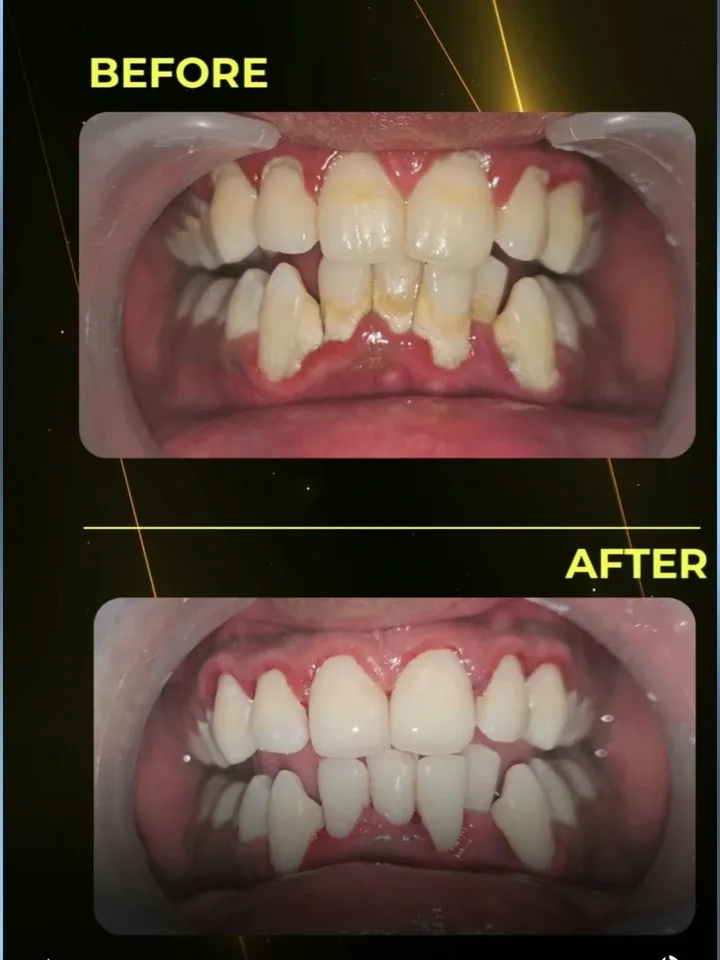
A real patient of ours, before and after one professional cleaning. The yellow-brown crust on the lower teeth is tartar. Underneath it, the enamel is intact.
Myth 3: Gaps appear between teeth after cleaning
Same story as Myth 1. Tartar fills the spaces between teeth and along the gum line. Remove it and the spaces reappear, especially where the gum had already receded from years of inflammation. Those gaps were there; they were packed with tartar and swollen gum. Over the two weeks after cleaning the gum tightens and heals, and the spaces usually look smaller than they did on day one.
Myth 4: Teeth stay sensitive forever after scaling
Sensitivity to cold after cleaning is common and temporary. The surfaces near the gum that were covered by tartar are exposed for the first time in years, and the gum takes a week or two to settle around them. Most people feel nothing within a few days; almost everyone is comfortable within two to three weeks. A sensitivity toothpaste speeds it up. Permanent sensitivity from cleaning does not happen.
Myth 5: If I brush well, I do not need professional cleaning
Brushing and flossing remove plaque, the soft film. But any plaque left behind for more than a day or two starts to harden into tartar, and once it hardens no brush can remove it. Even people with excellent brushing habits build some tartar in the spots a brush cannot reach: behind the lower front teeth, around the upper back molars, and just under the gum. That is what the six-monthly cleaning is for. It is not a substitute for brushing; it deals with what brushing cannot.
Myth 6: Once cleaned, teeth stay clean
Tartar starts forming again within days. The six-month interval exists because that is roughly how long it takes for new tartar to build to the point where it starts irritating the gum. People with gum disease, braces, diabetes or a smoking habit build it faster and need cleaning every three to four months. Think of it like a car service, not a one-time repair.
Myth 7: Scaling whitens teeth
Scaling removes tartar and surface stains from tea, coffee and tobacco, so teeth often look noticeably brighter afterwards. But it does not change the natural shade of the tooth itself. If your teeth are yellow rather than stained, that is a job for teeth whitening, which is a different treatment. A cleaning is always done first, because whitening works only on a clean surface.
What actually happens at a cleaning
- The dentist checks your gums and notes any bleeding or deep pockets.
- The ultrasonic scaler removes tartar above and just below the gum line, tooth by tooth. You feel vibration and cold water, not pain. Areas with inflamed gums may bleed a little during the cleaning, which is the inflammation being cleared.
- A fine hand instrument finishes the spots the ultrasonic cannot reach.
- The teeth are polished with a gentle paste to remove stains and leave the surface smooth, so plaque finds it harder to stick.
- You get specific advice on the spots you are missing when you brush.
The whole visit takes 30 to 45 minutes. If your gums are bleeding a lot or you have not had a cleaning in years, read our bleeding gums guide too; it explains what happens if gum disease has progressed and a deeper cleaning is needed.
What it costs
Routine scaling and polishing in Bangalore generally costs between ₹1,000 and ₹3,000, depending on how much tartar there is. A deep cleaning under the gum for gum disease is quoted separately. At The Tooth Corner the exact figure is confirmed after a look at your teeth and before we begin, like every treatment here.
If it has been more than six months, or you have never had a cleaning because someone told you not to, this is the sign to book one. Message us on WhatsApp and we will find you a slot. The clinic is in Green Glen Layout, Bellandur, open daily from 10 AM to 9 PM.